From Gatekeepers to Guides: The management shift that separates winners from the 75% that fail

Traditional governance keeps organisations safe. Transformation governance has to help them move.
By Paul Sala, Ibex Ascent Ltd.

Executive summary
Bottom line: transformation programmes rarely fail because the ambition was wrong. They fail because the organisation lacks a strong enough mechanism to turn ambition into sustained execution.
Most companies already have governance. They have steering committees, risk forums, audit controls, architecture boards, investment approvals, data policies, cybersecurity standards, and programme reporting. Those controls matter. They protect the business from legal, regulatory, operational, financial, and reputational harm.
But transformation needs something broader.
It needs a governance model that does not only ask, “Are we staying inside the lines?” It also needs to ask, “Which lines must move if we are going to create the future business?”
That is the shift from gatekeepers to guides. The mechanism is a Transformation Business Office: a business-led, highly empowered group that creates Guided Momentum by aligning leaders, owning outcomes, managing risk, adjusting priorities, funding the right work, and publishing results relentlessly.
This is not about weakening governance. It is about upgrading it.
The moment transformation starts to drift
Picture the steering committee.
The dashboard is mostly green. The vendor is mobilised. The platform design is underway. The PMO has a plan. Finance has approved the next tranche of spend. Risk, compliance, architecture, and security are engaged.
On paper, the transformation is moving.
But around the table, the tension is obvious.
The operations leader worries the business cannot absorb another process change this quarter. The CIO is worried about uptime and technical debt. Finance wants to know when benefits will become real. Risk and compliance want more evidence. Regional teams are asking for exceptions. Middle managers are quietly defending the old way of working.
This is where transformation begins to fail.
Not because people stop working hard. Not because the idea was bad. It fails because effort becomes disconnected from outcome.
The company is busy, but not aligned. Governance is active, but not decisive. Technology is progressing, but the business is not changing fast enough.
The executive challenge is not simply to approve the transformation. It is to create the conditions for the organisation to move together.
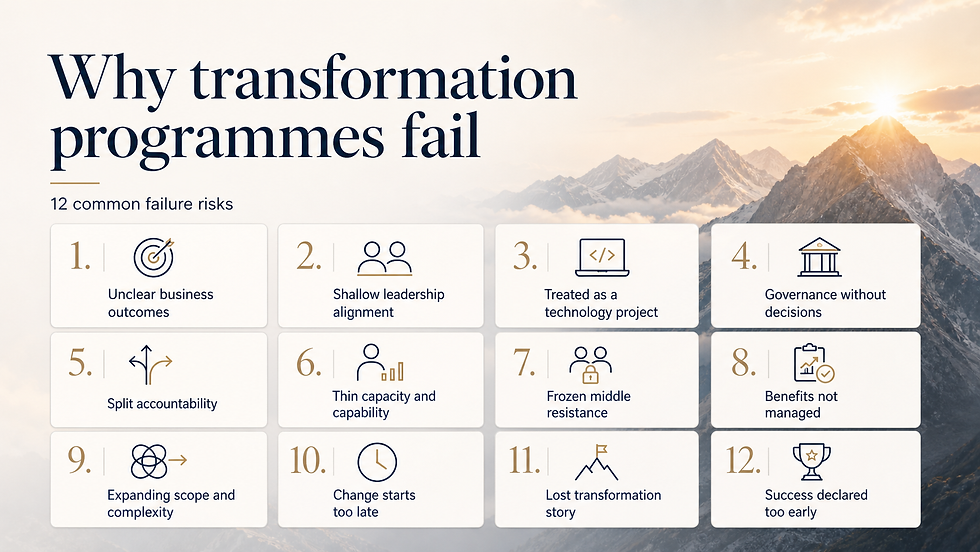
Why transformations fail
Research keeps pointing to the same problem: transformation is hard to land at scale.
BCG found that only 1 in 4 transformations deliver value-creating, enduring change. Gartner found that only 48% of digital initiatives meet or exceed their business outcome targets, while its highest-performing “Digital Vanguard” organisations reach 71% by having CIOs and non-IT executives co-own delivery and outcomes. BCG also found that more than two-thirds of large-scale technology programmes are not expected to be delivered on time, within budget, or within planned scope.
The pattern is not a lack of effort. It is misalignment between strategy, leadership, governance, capacity, culture, and measurable value.
The most common risks are predictable:
1. The transformation is not tied tightly enough to business outcomes.
2. Leadership alignment is too shallow.
3. The programme is treated as a technology project.
4. Governance creates reporting, not decisions.
5. Accountability is unclear between business and technology.
6. The organisation underestimates capacity and capability.
7. The frozen middle blocks momentum.
8. Benefits are assumed rather than managed.
9. Scope and complexity expand unchecked.
10. Change management starts too late.
11. The programme loses the story.
12. Leaders declare success too early.
The simplest executive diagnosis is this: transformation programmes fail when they are managed as delivery exercises instead of business-change systems.
Why traditional governance is not enough
Traditional IT governance grew up for good reasons.
Early enterprise technology was expensive, fragile, specialised, and difficult to change. Strict controls protected systems, customers, data, and operations.
Modern technology has only increased the need for control. Organisations now operate under regulatory scrutiny, cybersecurity threats, litigation exposure, data protection obligations, vendor risk, AI governance, cloud complexity, resilience requirements, and critical system uptime expectations.
So governance teams have been given a difficult job. They are expected to be gatekeepers of standards, controllers of systems and data, supervisors of audits, and protectors of legal, regulatory, security, architectural, and operational requirements.
That work is essential.
But it also creates a reputation problem. To many transformation teams, governance feels like the place where momentum slows. Where exceptions are challenged. Where evidence is requested. Where risk is raised. Where people hear what they cannot do.
The issue is not that governance exists. The issue is that transformation needs governance to do more than protect the current state.
Transformation is about creating a future state.
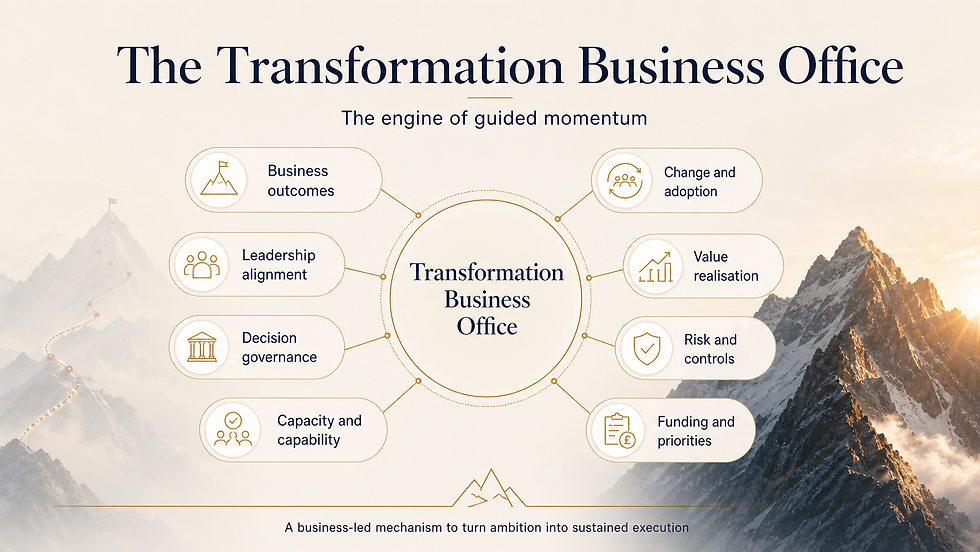
The management shift: from gatekeepers to guides
Executives do not need less governance. They need governance with a broader mandate.
The organisation still needs the teams that understand legal, regulatory, security, data, audit, architecture, privacy, resilience, and operational risk. Those teams keep the enterprise safe and credible.
But transformation also needs a business-led group that can do something different.
It needs a group that can imagine the future state and shape the path to get there. A group that can challenge current operating models, reshape teams, change roles and responsibilities, redirect priorities, pull financial levers, and create real ownership for business outcomes.
A group that can ask not only, “Are we allowed to do this?” but also, “Is this moving the business towards the outcome we committed to?”
That group is the Transformation Business Office.
The Transformation Business Office
A Transformation Business Office is not a PMO with a better title.
A PMO can track the work. A Transformation Business Office must help move the business.
Its role is to create Guided Momentum: the disciplined forward movement needed to turn transformation intent into business value.
It should be a highly empowered business-led office, chaired by someone capable of owning the intended business outcomes and value of the transformation. In many organisations, that chair should be a senior transformation leader reporting to the CEO, executive committee, or board.
The CIO and CTO must be central to the model. Their teams understand the technology estate, operational dependencies, data constraints, security requirements, platform risks, and delivery realities.
But the CIO and CTO are also responsible for keeping the current business running. That creates a structural tension. The same leaders being asked to maintain uptime, manage cyber risk, support operations, control cost, modernise platforms, and protect service are often also expected to drive deep business change.
Transformation needs technology leadership at the table. But it also needs a business-led office with the authority, capacity, and independence to push the organisation into the future.

How it creates Guided Momentum
The Transformation Business Office creates Guided Momentum by managing the failure risks before they become programme drift.
It should do eight things well.
1. Own the business outcomes. It forces a clear answer to: what value are we creating, for whom, by when, and how will we know?
2. Align leadership around trade-offs. It gives executives a place to decide what matters most when priorities, budgets, processes, or operating models collide.
3. Turn governance into decisions. Every forum should clarify what decision is needed, who owns it, what evidence is required, and what happens next.
4. Make business and technology jointly accountable. The business owns the business result. Technology owns the enabling platforms and architecture. Both are accountable for value.
5. Treat capacity as a strategic constraint. If the critical people are not available, the plan is not real.
6. Manage change and adoption from the start. Change is not the final workstream. It is the operating system of transformation.
7. Keep funding connected to value. The office should work with finance to redirect investment when assumptions change and benefits are not appearing.
8. Keep risk visible without letting risk stop all movement. Some risks must be avoided.
Some should be mitigated. Some may need to be accepted because the cost of doing nothing is greater.
This is the difference between governance that records friction and governance that removes it.
The transformations organisations are tackling now
This model matters because today’s transformation agenda is broader and more complex than a single platform programme.
Organisations are tackling AI and generative AI, cloud and platform modernisation, ERP and core system replacement, process and operating model redesign, cyber risk and resilience, and customer and digital experience improvement.

These transformations are different in content, but similar in failure pattern. They all require clear outcomes, business ownership, capacity, adoption, decision-making, risk management, and value tracking.
That is why a Transformation Business Office is powerful. It is not tied to one transformation type. It is the mechanism that helps any major transformation land.
The executive test
The test of transformation governance is not whether every meeting happened on time.
It is whether the organisation is making better decisions, faster.
Ask these questions:
· Can every executive explain the business value in one sentence?
· Are business outcomes owned by named leaders?
· Are business and technology jointly accountable for delivery and value?
· Does governance accelerate decisions, or only report status?
· Are critical people freed up to do the work?
· Is the middle of the organisation involved early enough to make the change real?
· Are benefits managed as actively as cost, scope, and timeline?
· Is change readiness visible before go-live?
· Are results published clearly and relentlessly?
If the answer is no, the programme may look busy while already drifting.
The takeaway
The future of transformation governance is not less control. It is better movement.
Existing governance teams keep the organisation safe, compliant, secure, resilient, and auditable. They are essential. But they cannot be the only model for transformation governance.
The organisation also needs a Transformation Business Office that can articulate the mission, align leaders, create business-owned outcomes, adjust priorities, direct resources, connect funding to value, manage risk, remove barriers, drive adoption, and publish results.
That is Guided Momentum.
It gives executives a way to lead transformation as a business-change system, not just a delivery exercise.
Because transformation is not simply about staying inside the lines.
It is about deciding, deliberately and responsibly, which lines need to move.
Clarity to Move. Confidence to Climb.


Comments