How to Get Value From Your Next Transformation Programme

A practical playbook for setting the direction, choosing the leaders, building the roadmap, and protecting the value.
By Paul Sala, Ibex Ascent Ltd.
Based on practical experience supported by research from Bain, McKinsey, BCG, and Deloitte on digital and large-scale transformation programmes.

Transformation work often starts with a platform, a programme name, and an ambitious go-live date. It should start somewhere simpler: what business outcome are we trying to create?
Most transformation programmes do not fail because the software was wrong. They fail because the business goal was fuzzy, the scope was too broad, the key leaders were only partly engaged, the roadmap ignored real dependencies, and the team focused more on launch than on whether the business actually changed.
The programmes that create lasting value usually do four things better.
They define a sharper outcome.
They put business and technology leaders in charge together.
They build a roadmap the organisation can actually deliver.
And they keep tracking benefits after launch instead of declaring victory too early.
At Ibex Ascent, we think of this as Guided Momentum: clear enough to align people, practical enough to deliver, and disciplined enough to protect value all the way through.
Go-live is not proof of success. The real test is whether the business runs better afterwards.
Playbook at a glance
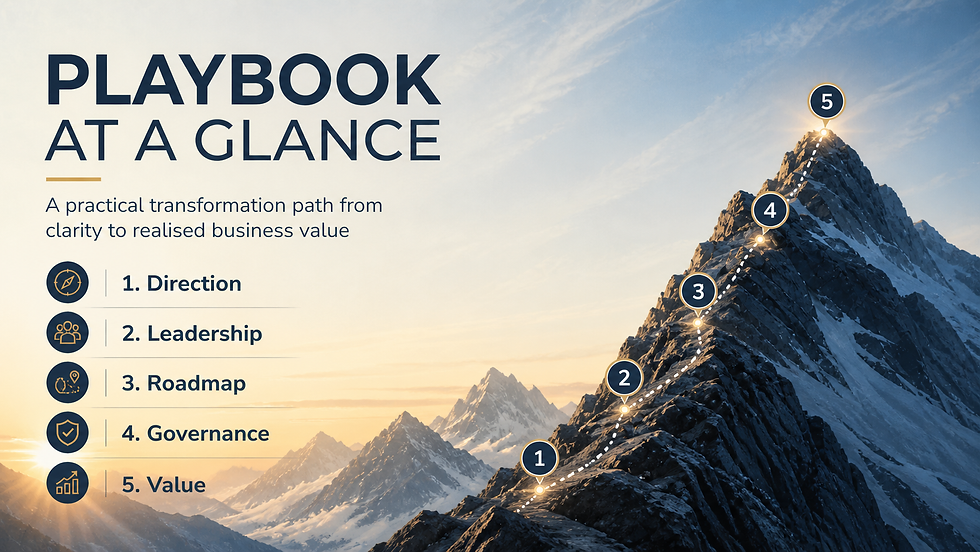
Phase | What good looks like |
1. Set the direction | Be clear about the business outcome, choose the right area to change, set a baseline, and make the value case plain before solution choices take over. |
2. Put the right leaders in place | Use visible executive sponsorship, shared business and technology leadership, a capable transformation office, and full-time leaders in the most important roles. |
3. Build a roadmap the business can really deliver | Sequence the work in sensible waves, surface dependencies early, plan for process and data change, and staff the work with realistic assumptions. |
4. Run the work with Guided Momentum | Use active governance, track value and risk, manage partners well, and combine agility with enough control to keep the programme on course. |
5. Hold on to the value after go-live | Measure adoption and business impact, not just delivery dates, and keep governing long enough for the benefits to show up and stick. |
1. Set the direction before solution choices take over
The first job in a transformation is not picking a platform. It is being honest about the result you want.
Leaders need to answer four questions early:
What outcome matters most?
Where in the business will that outcome come from?
What new capabilities are needed to get there?
What trade-offs are we willing to make when time, money, or people run short?
This is where many programmes start to drift. The goal sounds important, but it is not specific enough to guide decisions. The scope keeps expanding. The business case is created once, then buried. The team becomes busy, but not necessarily aligned.
A better approach is to choose a transformation size the business can actually handle. Big enough to matter. Small enough to deliver.
Before workstreams get moving, put a simple value case on the table. Define the current baseline, target outcomes, leading indicators, major milestones, and named owners for the benefits. You do not need fake precision. You do need enough clarity to make good trade-offs later.
What this creates: a sharper summit, a clearer route, and fewer arguments about what the programme is really meant to achieve.
2. Put the right leaders into the hard roles
Transformation programmes rarely fail because too many strong leaders showed up.
They fail because accountability is blurred, leaders are only half engaged, or the hardest roles are treated like side jobs.
Strong transformation leadership usually works at three levels.
First, there needs to be a visible executive sponsor who keeps the work tied to real business results and clears roadblocks when the team gets stuck.
Second, business and technology need to lead together. Transformation is not an IT delivery exercise with occasional business input. It is business change enabled by technology. Shared leadership helps the team make better decisions about value, complexity, risk, process, data, and adoption.
Third, the programme needs people whose full job is to drive the change. That usually means a clear transformation lead, empowered workstream owners, and a transformation office that does more than run status meetings. It should connect planning, change, architecture, delivery, dependency management, and benefit tracking.
Leadership cannot be part-time if the programme is mission-critical. When the people carrying the hardest parts of the work are stretched across five other priorities, the odds get worse before delivery has even started.
What this creates: clearer ownership, faster decisions, better escalation, and steadier leadership when pressure rises.
3. Build a roadmap the organisation can actually carry

A transformation roadmap should be more than a list of projects and dates. It should show the order of work, the dependencies, the decision points, the capability gains you expect, and the people needed to keep the whole thing moving.
Many roadmaps are really just timelines. They show when someone hopes something will happen, not what has to be true for it to happen.
A stronger roadmap is built around capabilities, not just releases. Do not ask only when a module will go live. Ask when the business will forecast better, close faster, serve customers differently, reduce risk, or cut cost. That keeps the work connected to the outcome people actually care about.
The roadmap also needs honest assumptions. What data problems already exist? Which process changes will be hardest? Where are the handoffs between teams? How much time can the business really give to design, testing, training, and cutover?
This is also where leaders need to make deliberate choices about standardisation. In some areas, the smart move is to simplify and adopt a common way of working. In others, the business may need a tailored approach because the process is a source of advantage or because regulation demands it. The point is to choose on purpose, not by drift.
What this creates: a route the business can follow, with fewer surprises hidden in the terrain.
4. Run the work with Guided Momentum

Programmes that miss the mark often spend months planning the future solution and too little time planning how the work itself will run.
Before execution starts, the team should be clear on decision rights, risk escalation, scope control, benefit tracking, and partner management. Governance should not become a weekly status pack that reports problems after they have already grown. It should create the conditions for safe forward movement.
A useful model is layered:
Workstreams review commitments, blockers, dependencies, and risks frequently.
The programme team looks across the whole plan and makes integrated decisions about progress, priorities, money, capacity, and sequencing.
The steering group handles the big trade-offs and the issues nobody else can unblock.
If every decision goes upstairs, the model is too weak. If nothing important reaches leadership, they are too far away.
The delivery method matters too. In many transformations, a mixed approach works best. Use clear gates and integrated planning for risky dependencies, but still deliver in steps, test early, and show progress in ways the business can see.
External partners can help, but the organisation still has to own the outcome. Clear roles, aligned incentives, and active partner management make a real difference.
And none of this works if change is treated as an add-on. People need a clear story, new behaviours, practical training, cross-functional working, and enough support to adopt the new way of operating.
What this creates: clarity without bureaucracy, pace without chaos, and momentum the business can trust.
5. Hold on to the value after go-live

Go-live is not the finish line. It is the point where the real test begins.
This is when the business either starts using the new tools and ways of working well enough to get the promised gains, or quietly slips back into old habits.
It helps to track three kinds of measures at the same time:
Delivery measures: milestones, defects, spend, risk, and readiness.
Adoption measures: training completion, active use, process compliance, cycle time, and user confidence.
Business measures: revenue, cost, service, forecast accuracy, working capital, risk reduction, or whatever the programme promised in the first place.
Skills matter after launch too. New tools do not create value by magic. People still need to know how to use them, manage them, and improve the work around them.
The final piece is sustainment. Benefits fade when ownership snaps back to business as usual before the new habits are stable. Keep the governance in place long enough to prove that the process is sticking, the performance measures are holding, and the business case is showing up in real numbers.
The right closing question is not, “Did we deliver the programme?”
It is, “Are we now running the business better than before?”
A practical checklist for leaders
Before your next transformation moves into delivery, test it against these questions:
Can we describe the business outcome in one clear sentence?
Do we know the baseline and the target?
Is the scope meaningful but manageable?
Are business and technology visibly leading together?
Are the critical roles filled by people with enough authority and time?
Does the roadmap show dependencies, not just dates?
Have we planned for process, data, people, and adoption, not just system build?
Do we know how decisions will be made and escalated?
Are partners clear on outcomes, roles, and accountabilities?
Will we keep measuring value after go-live?
Most of this is not mysterious. It is just harder than people want it to be. Better software will not rescue a weak programme. A slick plan will not save a team that cannot make decisions. And a go-live date is not proof of success.
The programmes that do well treat transformation as serious business change from the start, with technology playing an important role but not pretending to be the whole answer.
Ready to move with more clarity?
Whether you are shaping a transformation, aligning technology to business priorities, redesigning your operating model, or looking for experienced fractional technology leadership, Ibex Ascent can help.
We bring calm, practical leadership to complex change, helping organisations create clarity, build alignment, open paths through complexity, and deliver value people can see.
Clarity to Move. Confidence to Climb.
Further reading
Bain & Company. Orchestrating a Successful Digital Transformation
Bain & Company. Four Myths of Digital Transformation: What Only 8% of Companies Know
McKinsey & Company. The keys to a successful digital transformation
McKinsey & Company. Digital transformation: Improving the odds of success
McKinsey & Company. Three new mandates for capturing a digital transformation’s full value
McKinsey & Company. What is digital transformation?
McKinsey & Company. The science behind transformations: Protecting value from day one
Boston Consulting Group. Most Large-Scale Tech Programs Fail: How to Succeed
Deloitte. Orchestrating complex transformations
Deloitte. Maximising value from transformations
Deloitte. How to lead digital transformation from the top
Bain & Company. CTO Insights: Talent Is Key to a Transformation’s Success
Bain & Company. 88% of business transformations fail to achieve their original ambitions



Comments