Shared Accountability Is Not Consensus. It Is Designed Ownership.

Bottom line: Transformation value is now created across functions, but accountability is often still assigned as if one heroic leader can carry the outcome alone. Shared accountability only works when ownership, decision rights, and outcome measures are deliberately designed.
|
Executive summary
Most transformation programmes do not fail because leaders lack ambition. They fail because accountability is designed around the wrong unit of work.
For years, organisations have relied on heroic leadership: a senior sponsor, programme director, CIO, COO, or transformation lead who is expected to cut through complexity, resolve conflict, create momentum, and somehow deliver value across business, technology, operations, finance, risk, and customer teams. That model can create short-term movement, but it rarely creates durable business outcomes. Transformation value is created across functions, but accountability is often still assigned to individuals inside functions.
The shift now underway is from hero leadership to shared accountability: not a soft model where everyone gets a voice, but a deliberate operating model where outcomes, decision rights, measures, and ownership are designed across the value stream.
The leadership shift is not from one accountable person to no accountable person. It is from individual heroics to deliberate, outcome-based ownership.

The problem with hero leadership
Hero leadership is attractive because it feels decisive. When an organisation is stuck, a strong individual leader can bring energy, confidence, and direction. In a crisis, that matters. In a complex transformation, it is not enough.
The heroic model concentrates accountability in one person while the levers of delivery sit elsewhere. The transformation leader may be accountable for the programme, but the business owns adoption. Technology owns systems. Finance owns benefits tracking. Operations owns process change. HR owns capability. Risk owns control. Customer teams own experience. The named leader becomes accountable for an outcome they cannot fully control.
It also allows functional leaders to remain adjacent to the transformation rather than truly committed to it. They attend steering committees, review milestones, and approve papers, but the work remains 'the programme's problem'. Once transformation becomes something being done to the business rather than by the business, momentum becomes fragile.
The issue is not that heroic leaders are bad. The issue is that heroics are a poor substitute for design.
What the research tells us
Leadership research increasingly examines shared, collective, distributed, or plural forms of leadership. The practical conclusion is not that hierarchy disappears. It is that complex work needs more than vertical authority. When outcomes depend on interdependent teams, leadership must be distributed through the work, not merely delegated down a reporting line.
Operating-model research points in the same direction. Organisations lose value when strategy and execution are separated by weak operating models, unclear team structures, and poor links between work and business outcomes.
Taken together, the message is clear: shared accountability works when it is engineered into the operating model. It fails when it is treated as a cultural aspiration.
|
How firms are coping with the ownership question
The ownership question is the hardest part of shared accountability. Executives are right to be wary. 'Shared ownership' can easily become blurred ownership. It can lead to slow decisions, circular debate, unclear escalation, and diluted responsibility.
The better organisations are not abandoning individual accountability. They are distinguishing between different types of ownership. Owning the outcome is different from owning the work. Owning the work is different from advising on the decision. Advising on the decision is different from having the right to make it.
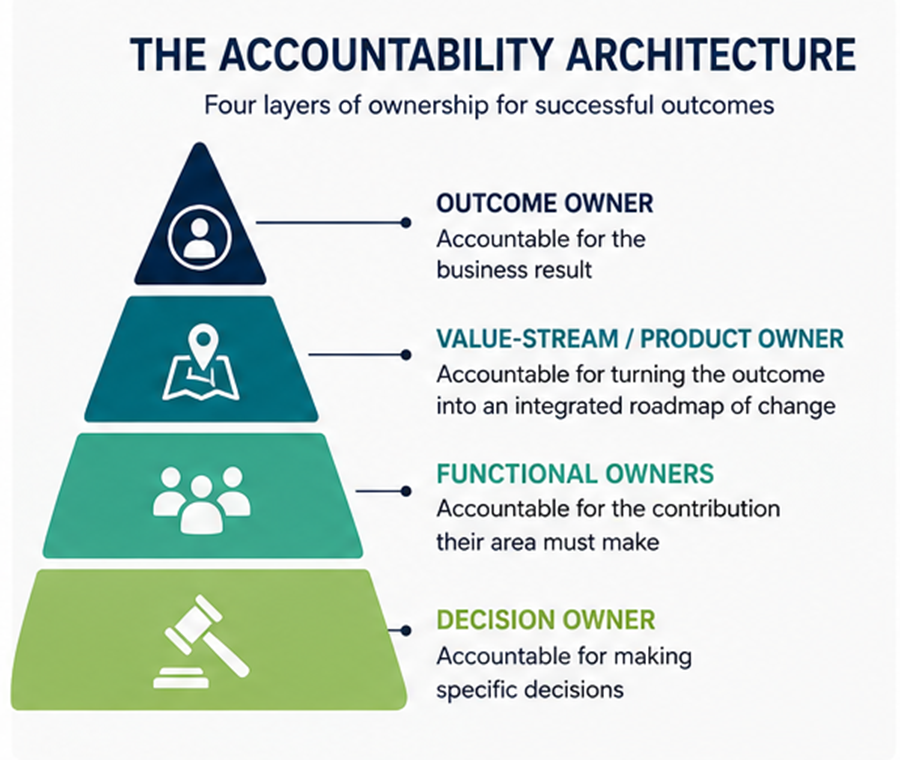
Outcome owner: Accountable for the business result. This is usually a senior business leader who owns the commercial, customer, operational, or strategic outcome.
Value-stream or product owner: Accountable for turning the outcome into an integrated roadmap of change across process, technology, data, controls, and adoption.
Functional owners: Accountable for the contribution their area must make, such as platform readiness, process adoption, benefit validation, capability, or control alignment.
Decision owner: Accountable for making a specific decision, which may vary by decision type: funding, scope, risk, customer impact, architecture, policy, operating model, or benefit trade-off.
Implications for organisational structure
Shared accountability has structural consequences. It is not simply a change in leadership language.
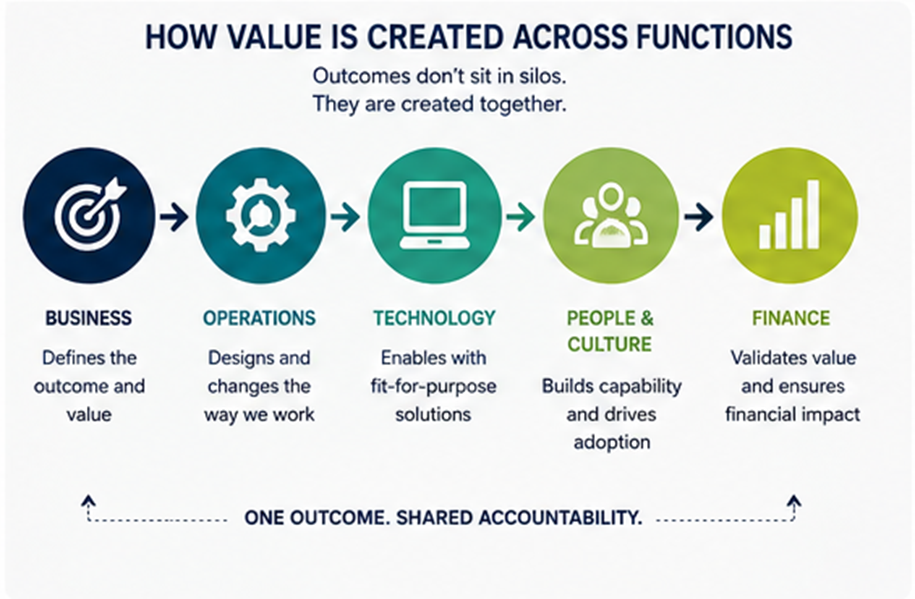
Traditional organisations are designed around functions: sales, operations, technology, finance, HR, risk, legal, product, and service. That structure creates specialism, control, and efficiency. But transformation value is usually created across those boundaries.
The right structure depends on the business model, regulatory environment, scale, and nature of work. But the direction of travel is consistent: organisations need clearer connective tissue between strategy, funding, delivery, adoption, and value.
Functional structures can remain, but they should no longer be the only axis of accountability. Cross-functional outcome teams should be established around value streams, customer journeys, platforms, or strategic capabilities.
Implications for team management
Shared accountability also changes how teams are managed. In a hero-led model, teams often wait for direction, escalation, or permission. In a shared-accountability model, teams need enough clarity to act without constant executive intervention.
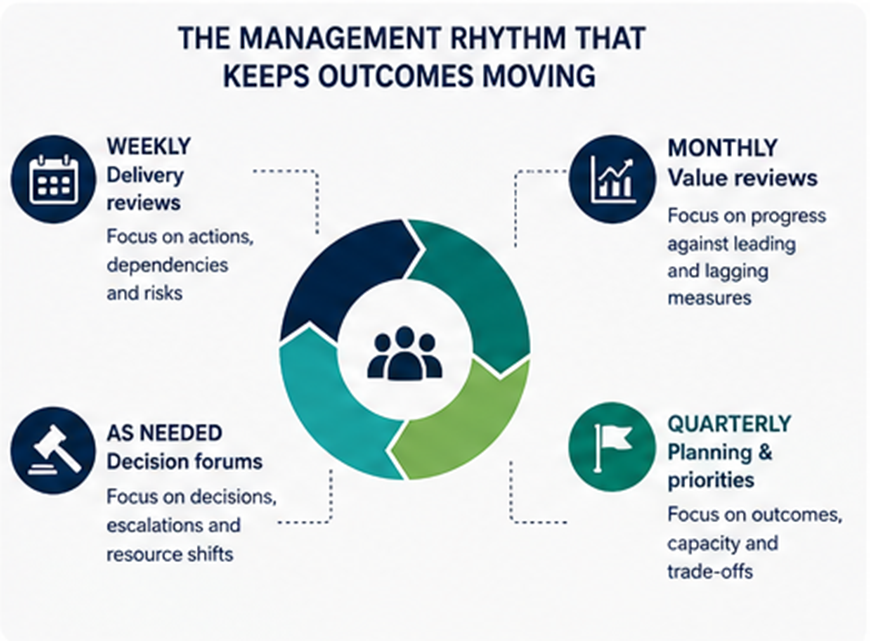
Teams need a clear business outcome, not just a task list. They need boundaries around budget, risk appetite, architecture, regulation, customer commitments, and non-negotiables. They also need decision rights, shared measures, and a management rhythm that connects delivery activity to value creation.
Weekly delivery reviews, monthly value reviews, quarterly planning, and executive decision forums should be connected. Otherwise, teams manage tasks in one forum, risks in another, benefits in another, and decisions somewhere else entirely.

Avoiding the "everyone and no one" trap
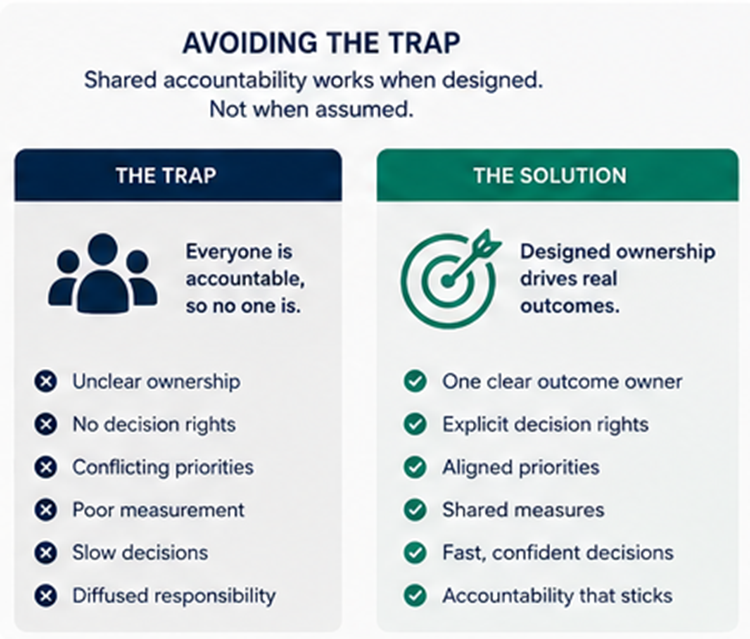
The most common criticism of shared accountability is fair. If everyone is accountable, no one is.
This happens when organisations confuse collaboration with ownership. Collaboration means many people contribute. Ownership means someone is answerable for the outcome, the decision, or the work.
Shared accountability avoids the trap when it follows six rules.
1. One outcome, named clearly: The outcome must be specific enough to manage. "Improve customer experience" is not enough. "Reduce mortgage application turnaround from 21 days to 7 days while maintaining risk controls" is better.
2. One ultimate outcome owner: Shared accountability does not remove the need for an accountable executive. It changes what that executive is accountable for.
3. Multiple contributing owners: Each function must own its contribution. Shared accountability should make functional ownership sharper, not softer.
4. Explicit decision rights: Every major transformation should define decision rights for funding, scope, solution design, risk acceptance, policy change, customer impact, benefit trade-offs, and go-live readiness.
5. Shared measures with leading and lagging indicators: A lagging benefit measure tells you whether value arrived. A leading measure tells you whether the organisation is changing in the way required to create that value.
6. Governance that forces resolution: Governance should not merely collect status. It should force trade-offs into the open and decisions to the right level.
The executive shift: from heroic intervention to designed accountability
The executive role does not become less important in shared accountability. It becomes more important. The difference is where the executive adds value.
In the hero model, executives intervene when the system fails. They resolve escalations, push decisions through, challenge delays, and personally broker alignment.
In the shared-accountability model, executives design the system so fewer heroic interventions are required. They clarify the outcome. They appoint the right owners. They define decision rights. They align incentives. They remove structural conflict. They ensure the management rhythm focuses on value, not just delivery.
This is a more mature form of leadership. It is less theatrical, but more effective.
Instead of asking... | Ask... |
Who is running the programme? | Who owns the outcome? |
Are the workstreams green? | Are the business measures moving? |
Have we agreed the governance? | Can the right people make the right decisions at the right speed? |
Is everyone engaged? | Does every function understand what it owns, what it can decide, and how its performance contributes to the outcome? |
What this means for transformation leaders
For transformation leaders, the message is clear: do not sell shared accountability as a cultural ideal. Design it as an operating discipline.
Start with the outcome. Then map the value stream. Identify the functions required to deliver it. Define ownership at each layer. Set decision rights. Align measures. Build the cadence. Test whether the system works by asking: when a decision is difficult, when a trade-off is painful, or when performance drops, does the organisation know who acts?
If the answer is no, accountability has not been designed. It has only been discussed.
Shared accountability is not about removing hierarchy, weakening leadership, or replacing decisive action with consensus. It is about matching the accountability model to the reality of how value is created.
Transformation is now too interconnected to be carried by a single hero. But it is also too important to be left to vague collective responsibility.
The organisations that succeed will be those that make accountability shared, but never ambiguous.

|



Comments